Bidirectional. Line-level. Per-visit dates.

Your invoices, taxes, and material costs — automatically in QuickBooks.

Most field service platforms claim "QuickBooks integration" and what they mean is one-way push of a customer name and a total. Not CrewHub360. We push line items with quantities, unit prices, Job & PO numbers, the date the work was actually done, and tax codes resolved by service address. And when your accountant changes something in QuickBooks, it flows back automatically.

Owners and accountants who hate double-entry

If you're paying a bookkeeper to retype your invoices into QuickBooks, or you're rekeying payments yourself, you're losing 3–4 hours a week per 100 invoices. CrewHub360 closes that loop with a real, line-level, bidirectional sync.

Accountants & bookkeepers Owners Office managers

Line-level invoice push (not just a total)

Every line on every invoice pushes to QBO with quantity, unit, unit price, the right item from your price book, a description that includes Job # and PO # if applicable, and the date the work was actually done. Your books reflect what actually happened in the field, not a single rolled-up total.

  • Per-line quantity, unit, price, and the right item from your price book
  • Descriptions include Job # and PO # so every line is traceable
  • The date the work was actually done (not just the invoice date)
  • For items not yet matched, choose to create them automatically or fall back to a default item
CrewHub360 invoice with line-level detail pushed to QuickBooks
Line-level invoice push — qty, unit, price, Job #, PO #, and the date the work was done
Tax codes resolved by service address

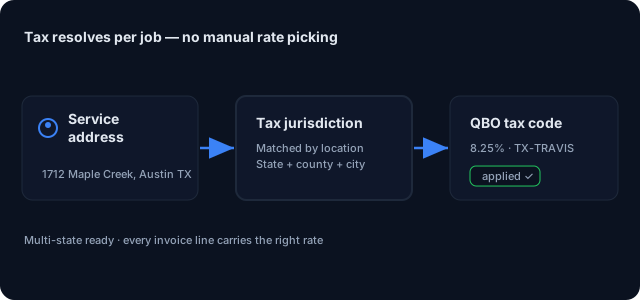
Multi-state operations live and die by tax accuracy. CrewHub360 links each service address to a tax jurisdiction, so the right tax code is applied automatically based on the job's address. When the invoice pushes, the right tax code lands per-line based on where the work was performed — not where you're headquartered.

  • Service address → tax jurisdiction → QBO tax code mapping
  • Per-line tax (not flat invoice tax)
  • Multi-state ready out of the box
  • Admin UI for jurisdiction management
Tax codes resolved per job from service address to jurisdiction to QBO tax code

Payments, credit memos, bills, material costs — all two-way

Sync isn't just invoices. Payments push with the matching payment method and Job-level reference. Credit memos for refunds and adjustments. Bills for vendor expenses. Material costs push when materials are used on a job. If a sync fails it retries on its own and never duplicates anything.

  • Payments with the matching payment method you set up
  • Credit memos for refunds (preserves audit trail)
  • Vendor bills push as expenses
  • Material costs calculated when a job closes, attributed to the right items
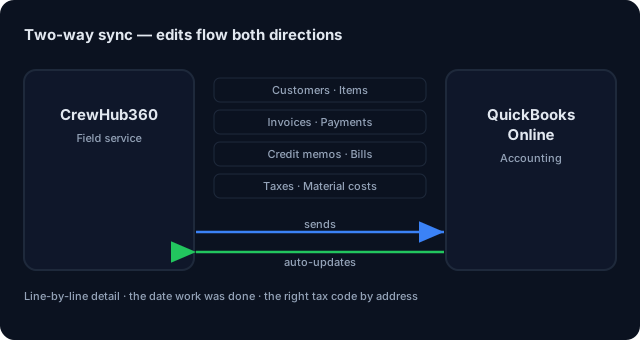
Bidirectional QuickBooks Online sync across customers, items, invoices, payments and more

Changes in QuickBooks flow back automatically

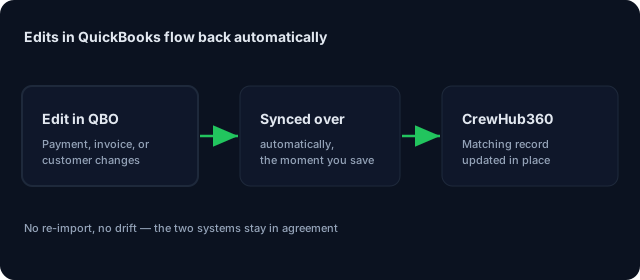
When your accountant changes something in QuickBooks, it flows back automatically and updates the matching CrewHub360 record. Your accountant can fix a typo in QBO and CrewHub360 picks it up. Every sync is logged so you can see exactly what happened — with timestamp, status, and error trail if applicable.

  • Changes made in QuickBooks flow back automatically
  • Every sync logged with status and any errors
  • Manually retry any sync from the sync history
  • If a sync fails it retries on its own and never duplicates anything
Edits made in QuickBooks Online flow back to CrewHub360 automatically

Round out the back-office stack

QuickBooks sync: common questions

What syncs to QuickBooks Online?

Customers, service items, invoices, payments, credit memos, bills, tax codes, and material costs. Every sync is logged so you can see exactly what happened.

Is the sync bidirectional?

Yes. We push changes from CrewHub360 to QBO, and when your accountant changes something in QuickBooks, it flows back automatically. If your accountant edits an invoice in QBO, CrewHub360 picks up the change.

How are taxes handled?

The right tax code is applied automatically based on the job's address. The right tax code lands on the right invoice line based on where the work was done — important for multi-state operators.

Do invoice line items push with descriptive detail?

Yes. Each line pushes with quantity, unit, price, the Job # and PO # if applicable, and the date the work was actually done. No more generic 'labor' or 'materials' lines — your accountant sees exactly what was billed and when it happened.

How are payment methods mapped?

There's a simple setup step for matching your CrewHub360 payment methods to your QuickBooks payment methods. When a payment posts to QBO, the matching payment method is attached automatically.

What happens if a sync fails?

Every sync is logged so you can see exactly what happened. If a sync fails it retries on its own and never duplicates anything. You can view sync history per record and manually retry whenever you like.

Stop retyping invoices into QuickBooks

14-day free trial. Connect QBO whenever you're ready — included on every plan, full access from day one.

Start Your Free Trial